It Appears As If Two Doctors Are Talking
NIPT after PGT euploid transfer. Is it necessary ?
By Dr. Avanthi Vellala
Some patients come in having done their research. And some of that research is genuinely good the kind that makes the consultation sharper, the questions better, the decisions more grounded. I like it.
This couple came through word of mouth. An old patient of mine referred her
She was 30, he was 33. Five years of marriage. They had conceived spontaneously once, soon after their marriage but the heartbeat was not seen and it was terminated. After that, four failed OI cycles, two failed IUI cycles, a hysteroscopy. Years of trying and waiting and hoping. By the time they sat across from me, they were cautious. Hopeful, but carefully so.
I could see it in them. That particular kind of guarded hope that comes from years of waiting
They decided to go ahead with IVF. And they trusted me cautiously
Stimulation went well. 14 expected, 13 retrieved, 10 mature, 10 fertilised. Six frozen. We biopsied two both came back euploid.
They took some time before the transfer.
They came back for the FET. HRT cycle, single euploid blastocyst. Clean transfer.
Positive.
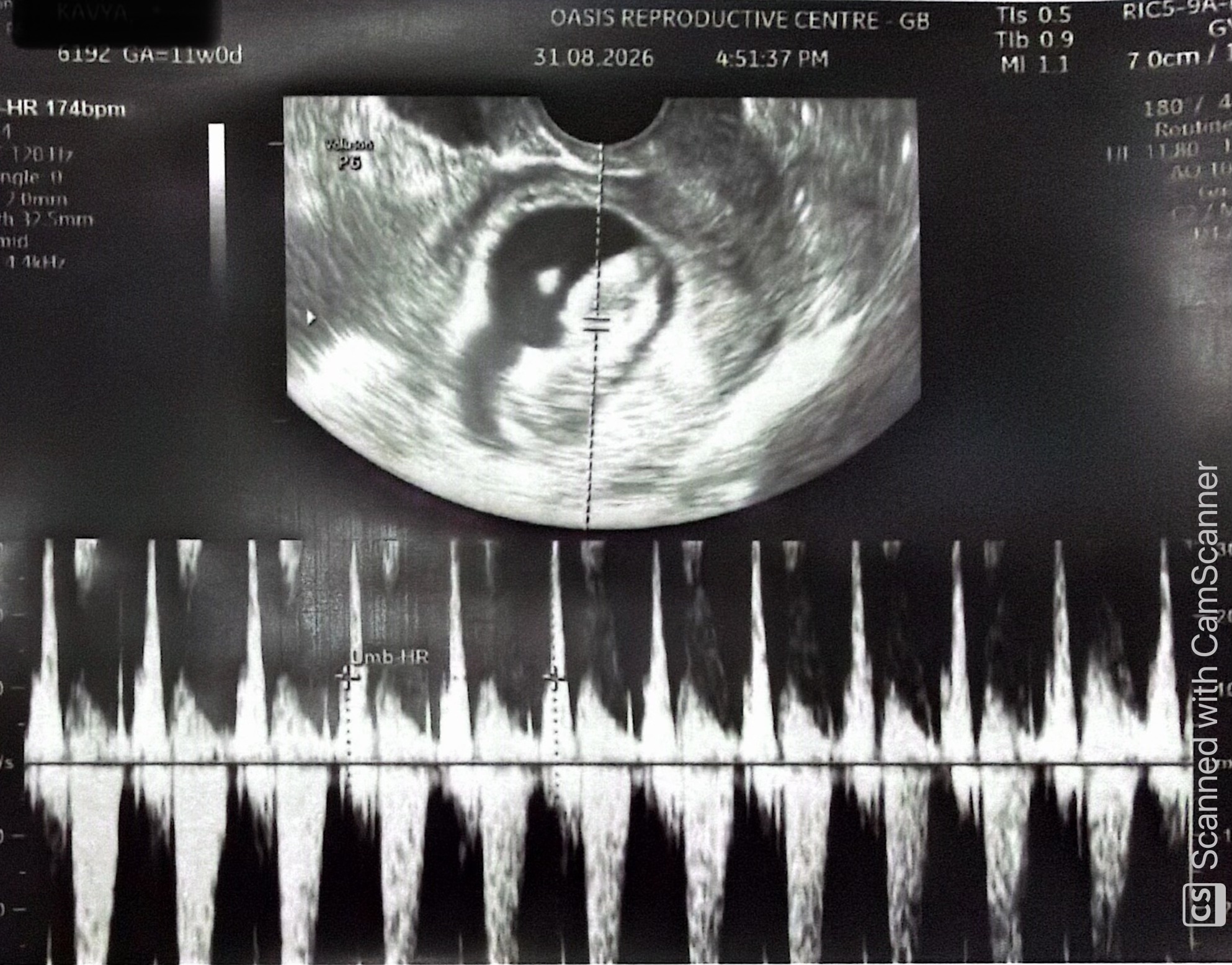
On the day the result came back, they couldn’t believe it. Her husband told me that they were seeing those two pink lines again for the first time in five years. He was happy. Really happy.
Every follow up scan after that her mother-in-law and husband came together. Both of them walked into the scan room when we called them to see the heartbeat. Every consultation post scan came with a list of questions
The last day I saw them before I referred them to their gynaecologist, I advised NT scan and NIPT as routine screening.
She looked at me and asked: “We transferred a PGT euploid embryo. Why do we still need NIPT and double marker?”
I genuinely loved this question.
I explained when we do PGT, we biopsy the trophectoderm the outer layer of the blastocyst. It is 98% representative of the inner cell mass the part that becomes the baby. But not 100%. There is a small but real possibility of discordance between the two. Which is why biochemical screening after NT scan, double marker or NIPT remains important even in a euploid transfer. It’s not that PGT failed. It’s that no single test is the last word.
Her husband looked at her a little stunned, a little proud and said
“It appears to me as if two doctors are talking to each other.”
I liked that when a husband is clearly in awe of his wife. She brought up exactly the right doubt at exactly the right moment. And when I explained it, she seemed to have understood.
She told her husband she’d been seeing a lot of fertility content on Instagram. That every time she scrolled, it was something fertility-related that came up.
I was happy but took it with a pinch of salt.
And here’s the thing. That’s good. A patient who reads and questions and wants to understand that makes my job better, not harder.
But there are still many who scroll the same content and come away with the opposite conclusion. Who believe PGT damages the embryo. Who think if PGT is normal, NIPT is unnecessary. Who are convinced by one post that an entire line of testing is redundant.
The same Instagram that made her ask the right question makes someone else ask the wrong one. The content is the same. The context is different. The doctor in the room is what makes the difference.
PGT is 98% representative, not 100%. That 2% matters. Biochemical screening after NT scan is not a lack of faith in the technology. It is the technology being honest about its own limits.
And patients who understand that the way she did are the ones who make the best decisions for themselves and their babies.